
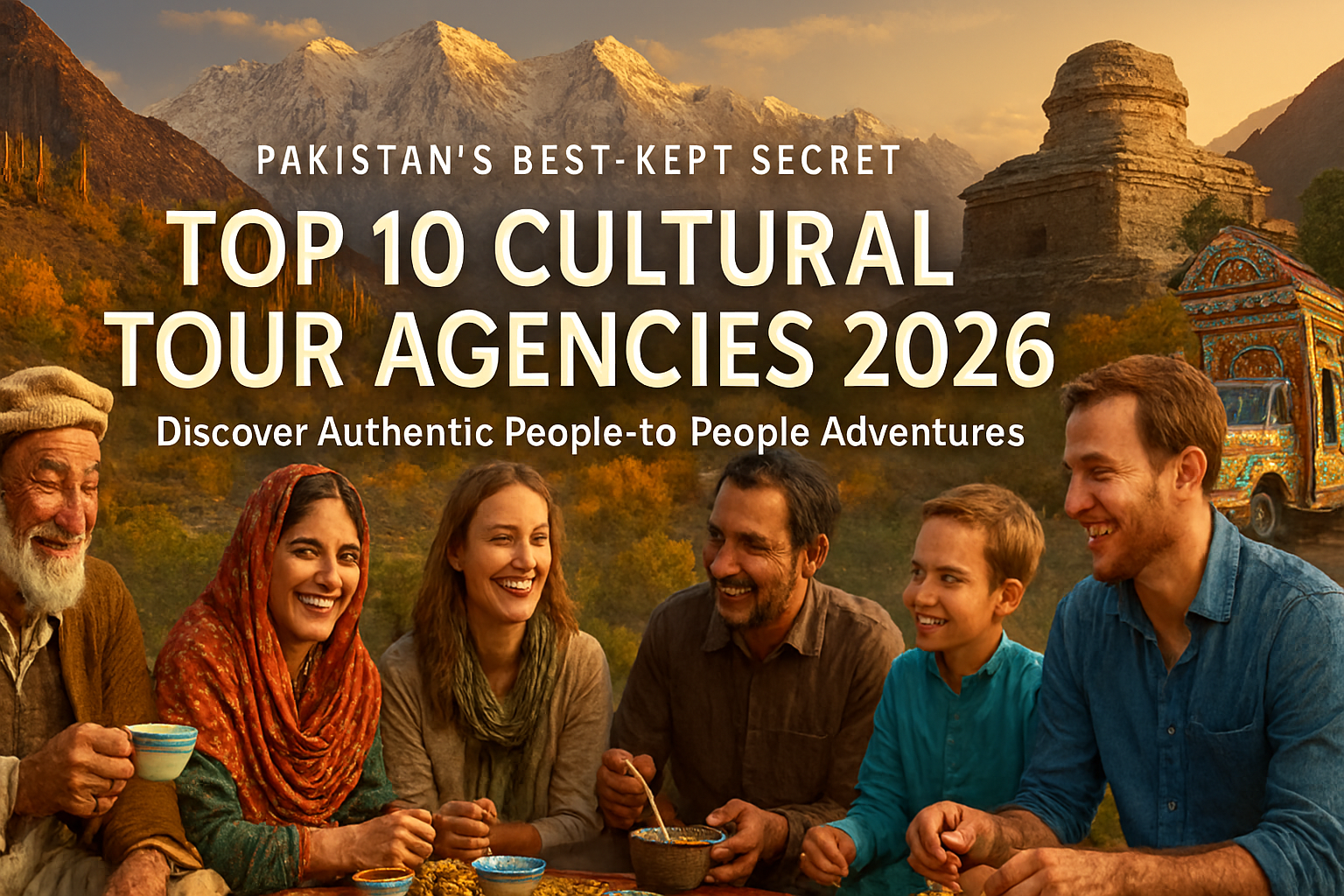
Discover the top 10 Pakistan tour operators specializing in authentic cultural immersion, people-to-people experiences, and sustainable travel in 2026. Expert reviews and insider tips.
On a crisp morning in Hunza Valley, I watched as my guide, a third-generation local whose grandfather had walked these same mountain paths as a porter for early mountaineers, poured traditional butter tea into delicate ceramic cups. We sat cross-legged in his family’s centuries-old home, its wooden beams carved with intricate geometric patterns, while his mother ground apricot kernels using a stone mill unchanged since the Silk Road era. This wasn’t a curated experience designed for tourists—it was Tuesday afternoon in a Hunza household, and I was simply there, welcomed as the guest Islamic tradition commands us to honor.
This moment crystallizes why Pakistan has emerged as one of 2026’s most compelling cultural tourism destinations, with the sector growing by 58% compared to 2023—a growth rate that surpasses regional competitors like Bangladesh. But these statistics tell only part of the story. What’s truly transforming Pakistan’s tourism landscape is a fundamental shift toward people-to-people travel: authentic encounters with local communities, cultural exchanges that transcend the transactional nature of conventional tourism, and immersive experiences that honor Pakistan’s layered heritage from the Indus Valley Civilization to contemporary mountain cultures.
Unlike the isolation of luxury resorts or the adrenaline-only focus of adventure tourism, people-to-people tours prioritize human connection. They’re about sharing meals in family homes, learning traditional crafts from master artisans, attending village weddings, staying in heritage properties owned by descendant families, and traveling with guides who offer not just geographical knowledge but intimate cultural insights born from lived experience. This approach aligns perfectly with global tourism trends emphasizing sustainability, authenticity, and responsible travel practices that benefit local communities while preserving fragile ecosystems.
Pakistan’s geography offers extraordinary diversity for cultural immersion. The northern valleys of Gilgit-Baltistan shelter communities speaking over a dozen languages, practicing ancient traditions like Wakhi pastoralism and Kalash polytheism. Punjab holds the architectural splendors of Mughal and Sikh heritage in Lahore, while Sindh preserves Sufi spiritual traditions and the archaeological wonders of Mohenjo-daro. Khyber Pakhtunkhwa bridges Central Asian and South Asian cultures in cities like Peshawar, where the Qissa Khwani Bazaar has echoed with storytellers’ voices for centuries.
Pakistan’s tourism industry is projected to expand at an average annual rate of 4.2% during the 2016-2026 decade, driven significantly by improved security conditions, simplified visa procedures (now largely online with e-visas available for over 175 nationalities), and growing international recognition of Pakistan’s tourism potential. According to data analyzed in recent tourism studies, the industry’s contribution to employment is expected to grow by 2.4% between 2016 and 2026, creating substantial economic opportunities particularly in underdeveloped mountain regions.
The post-pandemic era has fundamentally reshaped travel priorities. A 2024 World Economic Forum report notes that travelers increasingly prioritize authentic experiences and sustainable accommodation options, seeking off-the-beaten-path destinations rather than conventional tourist circuits. This shift particularly benefits destinations like Pakistan, where mass tourism infrastructure remains limited but cultural authenticity is abundant. The Asia Pacific region, which includes Pakistan, saw a record 33% increase in tourism in 2024 compared to 2023—higher than the global average of 11%—reflecting growing regional confidence and improved connectivity.
Pakistan’s unique position at the crossroads of South Asia, Central Asia, and the Middle East creates extraordinary cultural diversity. The country’s linguistic tapestry alone includes Urdu, Punjabi, Sindhi, Pashto, Balochi, and over a dozen regional languages in the northern territories—each representing distinct cultural traditions, cuisines, and worldviews. This diversity means that a two-week cultural tour can encompass experiences as varied as attending a Sufi qawwali performance in Lahore’s Data Darbar shrine, participating in a Kalash spring festival where pre-Islamic traditions persist, learning ancient Buddhist meditation practices at Taxila stupas, and sharing afternoon tea with Wakhi shepherds whose pastoral routes have remained unchanged for centuries.
The rise of community-based tourism models represents perhaps the most significant trend shaping Pakistan’s cultural tourism sector in 2026. As documented in recent sustainability research, community-based tourism (CBT) provides direct economic benefits to local communities while offering visitors authentic cultural encounters impossible in conventional hotel-based tourism. Pakistan’s northern areas have seen particular success with CBT initiatives, where homestays, locally-guided treks, and community-managed heritage sites ensure tourism revenue flows directly to mountain villages that have historically faced economic marginalization.
Selecting the right tour operator becomes crucial for meaningful cultural experiences. The agencies featured in this guide have been rigorously evaluated based on 2025-2026 reviews from platforms including TripAdvisor, TourRadar, and direct customer testimonials. Each excels in facilitating genuine local interactions, employs knowledgeable cultural guides (often from the regions they interpret), maintains strong community relationships, and demonstrates commitment to responsible tourism practices. Most importantly, these operators understand that the richest travel memories emerge not from checking landmarks off lists, but from moments of unexpected human connection—the laughter shared over perfectly spiced karahi, the humbling generosity of families who have little but offer everything, the profound silence of a Sufi shrine at dawn.
What follows is a carefully curated ranking of Pakistan’s finest operators for cultural and people-to-people tourism in 2026, each bringing unique strengths to the challenge of opening Pakistan’s cultural treasures to respectful, engaged visitors.
1. Rock Valley Tours – Local Expertise with Deep Community Roots
Founded by a team from the Karakoram mountainous regions, Rock Valley Tours has built its reputation on authentic cultural connections that emerge naturally from its guides’ lived experiences. Led by Manzoor and his team—many of whom hail from Shimshal Valley, one of Pakistan’s highest and most remote settlements—this operator offers unparalleled access to northern Pakistan’s mountain communities.
Cultural Specialization: Rock Valley’s signature strength lies in facilitating homestays and village experiences in areas where team members maintain family connections. Guests frequently highlight the opportunity to visit guides’ homes and observe authentic mountain lifestyles, from traditional bread-making to participation in local festivals like the Chilam Joshi celebration among the Kalash people. Their Shimshal Pass trek, for instance, isn’t merely a hiking expedition—it includes stays in porters’ family homes, meals prepared using traditional methods, and insights into the pastoral nomadic culture that has sustained these communities for generations.
The agency also excels in facilitating cultural tours through Lahore, Peshawar, and Islamabad. Recent reviews from December 2025 praised their careful curation of cultural and historical monuments, selection of restaurants serving authentic local cuisine, and expert navigation of Pakistan’s occasionally chaotic traffic—all while maintaining a warm, familial atmosphere.
Sustainable Practices: Rock Valley demonstrates commitment to environmental protection and community benefit. Their team emphasizes respect for natural habitats, often organizing cleaning expeditions alongside tourism operations. Importantly, by employing guides from the communities they visit and facilitating economic benefits through homestays and local purchases, they model sustainable tourism that genuinely uplifts mountain villages.
Pricing & Accessibility: Mid-range pricing with excellent value. Multi-day northern tours typically range from $1,500-$2,800 depending on duration and accommodation level. Private custom tours available.
Notable Reviews: Visitors consistently describe Rock Valley’s service as making them feel “like family”, with one Spanish traveler noting the planning process was “super quick and easy” while the trip itself was “perfect.” The flexibility to accommodate itinerary changes and handle logistical challenges (flight cancellations, road closures) earns particular praise.
Best For: Travelers seeking deep mountain cultural immersion, particularly in Hunza, Shimshal, Naltar, and Chitral valleys. Excellent for those who value authentic interactions over polished tourist experiences.
Considerations: As a smaller, locally-run operation, prices may fluctuate with fuel costs or economic conditions—a minor trade-off for genuine local expertise.
Contact: rockvalleytours.com | TripAdvisor Reviews
2. Exploria – Modern Professionalism Meets Cultural Depth
Exploria represents the new generation of Pakistani tour operators: professionally managed, digitally savvy, yet deeply committed to authentic cultural experiences. Co-founded by Ajmal Nawaz and his team, Exploria has rapidly built a reputation for meticulous planning, responsive communication, and guides who balance technical knowledge with emotional intelligence.
Cultural Specialization: Exploria excels in curating experiences that weave cultural immersion throughout adventure itineraries. Their Hunza Valley tours incorporate visits to ancient Baltit and Altit forts with context provided by historians, market visits guided by locals who explain traditional foods and crafts, and evening sessions with folk musicians. Visitors particularly appreciate guides like Karim, Fareed, and Rashid who are described as knowledgeable about Pakistan’s history and culture, offering insights that transform sightseeing into genuine understanding.
For solo female travelers, Exploria has developed specialized services including female guides like Anita who facilitate access to women-only spaces and provide cultural interpretation specific to gender dynamics in conservative communities—a thoughtful approach that recognizes cultural nuances while ensuring all travelers can experience Pakistan fully and safely.
The operator’s Hindu Kush tours demonstrate their cultural competence, taking groups through diverse accommodations from comfortable hotels to basic local guesthouses, ensuring travelers experience the authentic spectrum of Pakistani hospitality. Their southern Pakistan cultural circuits cover Karachi, the UNESCO sites of Mohenjo-daro and Makli Necropolis, and the Sufi heritage of Sindh and Punjab.
Sustainable Practices: Employs predominantly local staff, sources accommodations from community-owned properties where possible, and maintains ongoing communication with communities to ensure tourism benefits are distributed fairly.
Pricing & Accessibility: Premium-moderate pricing reflecting professional service standards. Multi-week tours typically $2,000-$3,500. Excellent value considering accommodation quality and guide expertise.
Notable Reviews: Clients praise Exploria’s flexibility in accommodating itinerary changes and their responsiveness throughout the journey. A Uruguay-based couple traveling over 3,000 kilometers highlighted how their guide and driver not only managed logistics perfectly but facilitated meetings with local people and exposure to folk music—going beyond scheduled activities to create meaningful encounters.
Best For: Travelers who want professional service without sacrificing authentic cultural encounters. Ideal for solo travelers, particularly women, and those seeking well-balanced itineraries combining nature, history, and cultural immersion.
Considerations: Sometimes books quickly during peak seasons (spring and autumn); advance booking recommended.
Contact: exploria.pk | TourRadar Reviews
3. Crossroads Adventure – Personalized Journeys with Cultural Sensitivity
Founded by Sultan Uddin, a Hunza native whose family connections and cultural knowledge span northern Pakistan’s diverse communities, Crossroads Adventure has distinguished itself through deeply personalized service and commitment to creating “life-enhancing experiences.” The operator’s small-group and private tour focus allows for flexible, culturally immersive travel that adapts to individual interests and pacing.
Cultural Specialization: Crossroads’ cultural strength derives from Sultan and his team’s status as insiders who can open doors that remain closed to conventional tourists. Guests regularly mention unique experiences like attending village weddings, dancing with locals, and having meals prepared in guides’ family homes—opportunities that reflect genuine relationships rather than staged “cultural shows.”
Their heritage tours excel at contextualizing Pakistan’s layered history. Visits to Gandhara Buddhist sites come with explanations of the region’s role as a crossroads between Central and South Asian civilizations. The Lahore cultural circuit includes not just the obligatory Badshahi Mosque and Fort visits, but also insights into Mughal-era urban planning, Sufi influences on Punjabi culture, and the city’s contemporary arts scene. The team’s knowledge extends to practical cultural navigation: understanding prayer times, explaining the significance of Friday congregations, and helping visitors dress and behave appropriately in religious sites.
Sustainable Practices: Crossroads maintains a strong sustainability philosophy emphasizing community benefit, cultural preservation, and environmental responsibility. They work with heritage properties that employ local staff, source meals from family-run restaurants, and contribute to community development projects.
Pricing & Accessibility: Premium positioning reflecting bespoke service. Tours range from $2,500-$4,000 for 10-14 day itineraries. Guaranteed departures with transparent pricing and no hidden costs. Deposits valid for two years, offering flexibility.
Notable Reviews: A visitor who had traveled to over 50 countries described Hunza as holding “a certain magic” not experienced elsewhere, crediting Crossroads’ team for making the cultural components as memorable as the landscapes. Multiple reviews emphasize the team’s ability to handle unexpected challenges (flight cancellations, landslides) while maintaining itinerary quality—a crucial skill in Pakistan’s sometimes unpredictable mountain regions.
Best For: Discerning travelers seeking premium, personalized cultural experiences. Excellent for those who value deep local knowledge, flexible itineraries, and sophisticated cultural interpretation. Vegetarians and travelers with specific dietary needs are well-accommodated.
Considerations: Higher price point reflects boutique service model. Not ideal for large groups or budget travelers.
Contact: crossroadsadventure.earth | TripAdvisor Reviews | TourRadar Profile
4. Gypsy Traces & Tours – Eco-Friendly Cultural Exploration
Led by founder Bakhsh and registered with Pakistan’s regulatory authorities (SECP, DTS, PATO), Gypsy Traces & Tours combines government licensing with a philosophy of eco-friendly, community-engaged travel. The company’s name reflects its core belief in the “gypsy” spirit of exploration—seeking authentic cultural encounters off established tourist circuits.
Cultural Specialization: Gypsy Traces excels in facilitating cultural immersion across Pakistan’s diverse regions, from the polytheistic Kalash valleys of Chitral to the Buddhist heritage sites of Taxila and Swat. Their ability to accommodate last-minute itinerary changes while providing “great suggestions on what else to do” reflects both flexibility and deep regional knowledge.
The operator’s Buddhist Heritage Tour exemplifies their cultural competence, tracing Gandhara civilization through Taxila, Peshawar Museum, Takht Bhai stupas, and Swat’s archaeological sites with scholarly interpretation that connects ancient Buddhist influence to contemporary Pakistani culture. Their Premium Pakistan Tour covers the cultural spectrum from Karachi’s cosmopolitan energy to Hunza’s mountain traditions, seamlessly blending historical sites with contemporary cultural encounters.
A solo Indian traveler particularly praised how Bakhsh created an itinerary offering “hands-on experience of what lies beyond the border”—testament to the operator’s ability to facilitate cross-cultural understanding and break down stereotypes through direct human contact.
Sustainable Practices: Officially registered as an eco-friendly operator. Emphasizes minimizing environmental impact, supporting local economies through employment and sourcing, and respecting cultural sites and traditions. Works with community-based accommodations and family-run restaurants.
Pricing & Accessibility: Competitive mid-range pricing. Week-long tours typically $1,200-$2,000. Flexible payment terms and visa assistance included. Two free date changes permitted with advance notice.
Notable Reviews: Multiple reviews describe Gypsy Traces staff as “some of the nicest people I’ve ever met” who made travelers feel like “honored guests”. German researchers conducting glacier fieldwork praised the team’s practical assistance, cultural knowledge, and hospitality that provided “unique insight into the culinary and culture of the Hunza valley.”
Best For: Eco-conscious travelers seeking authentic cultural experiences with strong community connections. Excellent for those exploring Buddhist heritage, Kalash culture, or Kashmir’s natural and cultural landscapes. Good value for budget-conscious travelers who won’t compromise on quality.
Considerations: Growing company still building infrastructure; some operational aspects may be less polished than larger competitors, though service warmth compensates.
Contact: gypsytours.pk | TripAdvisor Reviews
5. Pakistan Tour and Travel (PTT) – Comprehensive Cultural Circuits
Led by CEO Ejaz and based in Rawalpindi, Pakistan Tour and Travel has built a strong reputation for well-organized cultural tours that showcase Pakistan’s historical and natural heritage with impressive attention to detail. PTT’s strength lies in comprehensive itineraries that efficiently cover diverse regions while maintaining cultural depth.
Cultural Specialization: PTT excels in multi-region cultural tours that connect Pakistan’s geographical and cultural diversity. Recent tours covered Hunza Valley, Naltar Valley, Ayun, Kalash Valley, Chitral, and Peshawar with “excellent accommodations” like Ayun Fort Inn and Hindukush Heights hotels—properties chosen not just for comfort but for their cultural significance and local ownership.
The operator’s cultural approach emphasizes meaningful local interactions. Guides like Gulfam Hussain receive consistent praise for being “knowledgeable, personable, and great company,” offering insights that transform places into stories. PTT’s suggestion for guests to spend nights in Kalash Valley guesthouses—rather than returning to town hotels—exemplifies their commitment to authentic cultural immersion over tourist convenience.
Their cultural competence extends to practical matters: understanding kosher and halal requirements, respecting religious sensitivities during Ramadan, navigating complex family travel with young children and elderly parents, and managing the cultural and security protocols that can be opaque to foreign visitors.
Sustainable Practices: Employs predominantly Pakistani staff including many from the regions toured. Sources accommodations and services from locally-owned businesses. Organized approach minimizes environmental impact through efficient routing and waste management.
Pricing & Accessibility: Moderate pricing with transparent fee structure. Multi-week comprehensive tours typically $1,800-$3,000. Good value given breadth of coverage and accommodation quality. Family-friendly packages available.
Notable Reviews: A South African tour group emphasized PTT’s “immaculate service, flawless organization, and personal touches throughout the 14-day tour”, noting Ejaz’s impressive knowledge of Pakistan’s history, culture, and geography. Multiple reviews highlight how PTT maintained professionalism even when managing “challenging clients”—a mark of operational maturity.
Best For: Families and groups seeking well-organized, comprehensive cultural tours covering multiple regions. Ideal for first-time visitors who want efficient exposure to Pakistan’s diverse heritage. Excellent for those who appreciate professional service with cultural authenticity.
Considerations: Comprehensive itineraries can be ambitious; travelers seeking slower-paced, deeply immersive experiences in single regions might prefer more focused operators.
Contact: TripAdvisor Page
6. Hunza Adventure Tours – Valley Specialists with Cultural Insight
Established in 2010 by a group of young professionals from northern Pakistan, Hunza Adventure Tours brings over a decade of experience facilitating tours that balance adventure activities with cultural immersion. Their “Travel Made Possible” philosophy emphasizes accessibility—making Pakistan’s culture and landscapes available to diverse travelers through thoughtful planning and local expertise.
Cultural Specialization: As their name suggests, Hunza Adventure Tours excels in facilitating deep cultural engagement within the Hunza and broader Gilgit-Baltistan region. Visitors highlight how tours offered “opportunity to know the culture of the locals as well as taste the local foods and a walk to the villages”—experiences that transcend conventional sightseeing.
Their cultural tours incorporate visits to centuries-old forts like Baltit and Altit, but contextualize these sites within living culture: explaining how Hunza’s micro-kingdoms functioned, how irrigation systems sustained mountain agriculture, and how contemporary Hunza identity balances traditional practices with modernization pressures. Village walks include encounters with craftspeople producing traditional textiles, visits to organic apricot orchards that have sustained Hunza for centuries, and meetings with community elders who share oral histories.
The operator also offers strong cultural programming in southern Pakistan, covering Sufi shrines in Multan and interior Sindh, allowing travelers to experience the devotional music and spiritual practices that have shaped Pakistani Islam’s distinctive character.
Sustainable Practices: Local ownership and staffing ensure tourism benefits remain in communities. Emphasis on hand-picked, locally-owned accommodation and restaurants. Training programs for staff emphasize cultural sensitivity and environmental responsibility.
Pricing & Accessibility: Good value positioning. Tours range from $1,000-$2,500 for 7-14 day itineraries. Wide range of options from budget-conscious to more comfortable. Clear pricing with few hidden costs.
Notable Reviews: Post-COVID travelers praised how tour organizer Zahir “amended our itinerary a few times during our time in northern Pakistan” to ensure the best experience despite weather challenges and changing conditions. The mountain guides, cooks, porters, and helpers consistently receive praise as “amazing and friendly,” creating experiences where travelers “felt totally safe and enjoyed the great food.”
Best For: Budget-conscious to mid-range travelers seeking cultural immersion in northern Pakistan. Good for active travelers who want to combine trekking with cultural encounters. Excellent for those seeking authentic mountain culture experiences.
Considerations: Accommodation standards vary; budget options quite basic. Best suited to adaptable travelers comfortable with simple conditions in exchange for authentic cultural access.
Contact: hunzaadventuretours.com
7. Wild Frontiers – International Expertise with Pakistan Heritage
Wild Frontiers, a UK-based operator specializing in complex destinations, brings 25 years of Pakistan experience to cultural tourism. Pakistan is, in the company’s words, their “spiritual home”—they even founded a school in the remote village of Baleygon, demonstrating commitment that transcends commercial tourism. Their international perspective combined with deep local partnerships creates culturally sophisticated tours appealing particularly to Western travelers seeking expert curation.
Cultural Specialization: Wild Frontiers’ cultural tours reflect sophisticated understanding of Pakistan’s layered heritage. Their Kalash Valley experiences, for example, go beyond anthropological observation to facilitate genuine interaction: “visiting our Kalash friends in their homes allows you to interact with them, hear their stories and learn about their distinctive culture and lifestyle”—framing encounters as friendships rather than ethnographic spectacles.
The operator excels in contextualizing Pakistan’s position at civilizational crossroads. Tours examining Gandhara Buddhist heritage explain the Silk Road’s role in transmitting Buddhism to Central and East Asia. Lahore tours interpret Mughal architecture within broader Islamic artistic traditions. Their small group sizes (typically maximum 12) allow for meaningful discussions with local historians, artists, and religious scholars.
Wild Frontiers also includes signature experiences like the Wagah Border ceremony—the extraordinary daily flag-lowering ritual between Pakistan and India—framed not as jingoistic spectacle but as complex performance art reflecting Partition’s enduring impact on both nations’ identities.
Sustainable Practices: Long-term community investment (school founding) demonstrates genuine commitment. Employs local guides and partners with community-owned lodging. Award-winning approach to responsible tourism recognized by industry bodies.
Pricing & Accessibility: Premium pricing reflecting international standards and expert curation. Two-week tours typically £3,000-£4,500 (approximately $3,800-$5,800). Includes international expertise, comprehensive support, and high-quality accommodations.
Notable Reviews: Clients particularly value the seamless experience from UK departure to Pakistan return, with Wild Frontiers handling visa assistance, comprehensive pre-departure briefings, and 24/7 support. Cultural expertise of tour leaders (often academics or long-term Pakistan residents) receives consistent praise.
Best For: International travelers, particularly from UK, Europe, and North America, seeking expertly curated cultural experiences with comprehensive support. Ideal for first-time visitors to Pakistan who want professional international standards combined with authentic local encounters.
Considerations: Higher pricing reflects international operator model. Less flexibility than locally-based operators for custom itineraries. Group departure dates may not suit all schedules.
Contact: wildfrontierstravel.com/destination/pakistan
8. Intrepid Travel – Small Groups, Big Cultural Impact
Intrepid Travel, a certified B Corporation with decades of responsible tourism experience, brings rigorous ethical standards to Pakistan cultural tourism. Their commitment to using tourism “as a force for good” shapes every aspect of their Pakistan offerings, from guide selection to accommodation choices to community interactions. With over 4,900 reviews specific to Pakistan tours, their track record speaks volumes.
Cultural Specialization: Intrepid’s Pakistan cultural tours emphasize authentic, respectful engagement with local communities. Their itineraries are designed around meals in local homes, meetings with community organizations, and support for locally-owned businesses. The operator notes that “according to Islam, a guest is a blessing from God, and you’ll find that the locals will go out of their way to share a cup of tea, invite you in for a meal or strike up a conversation”—and their tours are structured to facilitate these organic encounters.
Their approach addresses important cultural realities directly. Regarding gender dynamics, Intrepid acknowledges Pakistan’s traditional views while highlighting women fighting for greater independence, including in tourism itself. They work with female guides and provide guidance for solo female travelers, recognizing cultural nuances without reinforcing stereotypes.
Food becomes a cultural portal in Intrepid tours. Guides don’t just identify dishes but explain regional variations—how nihari differs between Lahore and Karachi, why halwa puri is a Punjabi breakfast tradition, or how sajji reflects Balochi pastoral culture. Tastings occur in family-run restaurants where cooking methods remain traditional.
Sustainable Practices: B Corp certification ensures rigorous standards for social and environmental performance. Intrepid’s model dedicates substantial tour spend to local communities through accommodation, meals, guides, and activities. Carbon offset programs address travel impact.
Pricing & Accessibility: Mid-to-upper range reflecting international operator standards. Pakistan tours typically $1,500-$3,500 for 8-15 days. Comprehensive pre-departure support, insurance requirements, and quality guarantees.
Notable Reviews: Travelers consistently praise Intrepid’s cultural sensitivity and guide quality. The small group format (average 10 travelers) receives particular appreciation for allowing meaningful interactions impossible in larger groups.
Best For: Ethically-minded travelers seeking reputable international operator with strong responsible tourism credentials. Good for solo travelers wanting guaranteed small-group departures. Ideal for those who value structured cultural programming with expert interpretation.
Considerations: Fixed departure dates and itineraries offer less flexibility than custom operators. International operator model means slightly less intimate local connections than boutique Pakistani companies.
Contact: intrepidtravel.com/pakistan
9. Travel & Culture Services – Established Excellence Since 1997
Travel & Culture Services, operating under Government of Pakistan License No. 4428 since 1997, brings nearly three decades of experience to cultural tourism. Their longevity reflects operational excellence and deep relationships with Pakistani communities, heritage sites, and cultural institutions. The company serves as the Pakistan partner for major international operators including Adventures Abroad (USA & Canada), Swan Hellenic (UK), and Ikarus Tours (Germany)—testament to their professional standards.
Cultural Specialization: Travel & Culture Services’ name reflects their core mission: positioning travel as cultural education. Their extensive website features detailed articles on Pakistani cities, cultural practices, and historical contexts—demonstrating scholarly depth beyond typical tour operator content. This knowledge informs tour design that emphasizes understanding over mere observation.
Their Sindh Orient Tour exemplifies cultural sophistication, tracing the region’s layers from Indus Valley Civilization through Islamic Sufi traditions to contemporary Sindhi culture. The Punjab Potohar Tour connects prehistoric sites, Gandhara Buddhist heritage, Mughal architecture, and Sikh historical sites within coherent cultural narratives. Their 14-day South Pakistan Tour offers intensive cultural immersion across regions often neglected by northern Pakistan-focused operators.
The company maintains full-service offices with licensed guides in Karachi, Lahore, and Islamabad, ensuring consistent quality across Pakistan’s geographical and cultural diversity. This infrastructure allows for complex multi-region itineraries with seamless transitions.
Sustainable Practices: Long-term operation demonstrates commitment to sustainable business practices. Employs exclusively Pakistani staff. Works with heritage properties and cultural institutions on preservation projects. Promotes Pakistan’s positive image through educational content and responsible tourism practices.
Pricing & Accessibility: Moderate-to-premium pricing reflecting experience and professional infrastructure. Custom itineraries quoted based on requirements. Typically $2,000-$4,000 for comprehensive cultural tours. Handles all logistics including domestic flights, permits, and cultural site access.
Notable Reviews: International operators’ continued partnership over decades provides strongest endorsement. Clients praise operational reliability, guide expertise, and seamless handling of complex logistics—crucial for cultural tours requiring permits, special access, or coordination with religious institutions.
Best For: Travelers seeking established, reliable operator with deep cultural expertise and professional infrastructure. Excellent for academic groups, cultural institutions, and serious cultural tourism enthusiasts. Ideal for those exploring southern Pakistan’s often-overlooked cultural treasures.
Considerations: Premium pricing reflects operational scale. Less focused on adventure/trekking than specialized northern operators. More suitable for cultural depth than adrenaline activities.
Contact: travel-culture.com
10. PakVoyager – Personalized Service for Discerning Travelers
PakVoyager, led by the highly-regarded Mansoor, represents the boutique end of Pakistan’s tour operator spectrum—small scale, highly personalized, and built on owner-operator attention to detail. Reviews consistently highlight Mansoor’s responsiveness, transparency, and genuine care for client experience, creating tours that feel more like traveling with a knowledgeable friend than hiring a service provider.
Cultural Specialization: PakVoyager’s cultural strength derives from Mansoor’s extensive network of contacts throughout Pakistan’s tourism ecosystem—from heritage hotel owners to local historians to artisan communities. This enables unique cultural access: private viewings of manuscript collections, meetings with traditional craftspeople in their workshops, visits to family-run heritage properties closed to casual tourists.
A visitor noted that driver Mashgool “had vast knowledge of all the popular tourist sites and showed us some hidden gems that an outsider may never find”—reflecting how PakVoyager’s team combines expected cultural highlights with unexpected discoveries. The operator excels at creating itineraries balancing major cultural sites with authentic local experiences: a morning at Lahore Fort followed by afternoon tea with a family of miniature painters maintaining Mughal artistic traditions.
PakVoyager’s communication standards impress even travelers accustomed to first-world service levels. Clients describe Mansoor as “super responsive” with “very efficient, informative, clear and transparent” communication, essential for travelers navigating Pakistan’s occasionally challenging logistics (schedule changes, road closures, limited power) while maintaining cultural tour quality.
Sustainable Practices: Small-scale operation naturally emphasizes local relationships and community benefit. Works primarily with family-run accommodations and restaurants. Guides recruited from communities they interpret, ensuring cultural authenticity and economic benefit.
Pricing & Accessibility: Competitive mid-range pricing with high value-to-cost ratio. Custom tours typically $1,500-$2,800 for 10-14 days depending on accommodation level. Flexible payment arrangements. Comprehensive service including hotel bookings, reliable drivers, and constant accessibility.
Notable Reviews: An American visitor praised how PakVoyager made Pakistan travel “as easy or as difficult (adventurous?) as you like” while providing options throughout the journey. Multiple reviewers emphasize Mansoor’s integrity, noting that costs matched quotes with no hidden fees—important for travelers concerned about price inflation targeting foreigners.
Best For: Travelers seeking personalized, boutique service with owner-operator attention. Excellent for those who value responsive communication and flexibility. Ideal for visitors who want cultural depth with logistical ease, particularly in Hunza Valley where PakVoyager’s expertise is deepest.
Considerations: Smaller operation means limited capacity during peak seasons; advance booking essential. Less infrastructure for very large groups or multiple simultaneous tours.
Contact: pakvoyager.com
Choosing Your Cultural Journey: Practical Guidance for 2026
Selecting among these excellent operators requires honest assessment of your priorities, travel style, and cultural tourism goals. Consider these factors:
Budget Alignment: Operators range from budget-friendly (Hunza Adventure Tours, Gypsy Traces) through mid-range (Rock Valley Tours, PTT, PakVoyager) to premium (Crossroads Adventure, Wild Frontiers, Intrepid Travel). Higher prices generally reflect more comprehensive services, experienced guides, and better accommodations—but don’t necessarily guarantee better cultural access. Some of the most authentic experiences come through budget operators with strong community ties.
Regional Focus: Northern mountain culture specialists (Rock Valley, Hunza Adventure Tours, Crossroads) offer unmatched access to Gilgit-Baltistan’s diverse communities. For southern Pakistan’s Sindh and Punjab heritage, consider Travel & Culture Services or PTT. Multi-region coverage requires operators like Exploria or Intrepid with nationwide infrastructure.
Group Size Preferences: Solo travelers and couples have different needs than families or friend groups. Operators like PakVoyager and Gypsy Traces excel at personalized small-party tours. Intrepid and Wild Frontiers offer small-group departures with guaranteed dates—good for solo travelers wanting social experiences without solo surcharges.
Cultural Depth vs. Breadth: Intensive single-region immersion (spending two weeks in Hunza, for example) allows deeper cultural understanding but narrower geographical experience. Comprehensive multi-region tours offer diversity but necessarily sacrifice depth. Match itinerary style to whether you’re a first-time visitor seeking overview or returning traveler ready for deep dives.
Sustainability Commitment: If responsible tourism is priority, favor certified B Corps (Intrepid), eco-registered operators (Gypsy Traces), or those demonstrating long-term community investment (Wild Frontiers’ school, Rock Valley’s local employment). Ask operators directly about their sustainability practices and community benefit models.
Support Level Required: First-time visitors to Pakistan may value comprehensive support from international operators (Wild Frontiers, Intrepid) with 24/7 assistance and extensive pre-departure preparation. Experienced travelers comfortable with ambiguity might prefer local operators’ flexibility and intimate cultural access.
Cultural Sensitivity and Women’s Travel: Female travelers should inquire about female guides (available through Exploria, Intrepid), women-specific cultural programming, and operators’ understanding of gender dynamics. While Pakistan is generally safe for respectful female travelers, having guides who can navigate cultural nuances enhances both safety and access.
The Future of Cultural Tourism in Pakistan: 2026 and Beyond
Pakistan’s tourism market is expected to reach USD 4 billion in 2025 with user penetration touching 11.3%, driven significantly by the cultural and people-to-people segment. Several trends are shaping this growth:
Digital Transformation: Simplified visa procedures (now largely online) and improved digital connectivity make Pakistan increasingly accessible. Tour operators embrace social media for authentic storytelling, moving beyond generic marketing to share real cultural encounters that inspire travel.
Domestic Tourism Growth: Approximately 6.6 million domestic tourists explored destinations like Murree, Naran Kaghan, Swat, and Gilgit-Baltistan in 2023, boosting local economies while sometimes creating environmental stress. The challenge ahead involves managing this growth sustainably while ensuring cultural integrity isn’t compromised by commercialization.
Community-Based Tourism Models: Community-based tourism offers significant advantages including economic opportunity for locals, authentic experiences for visitors, and environmental protection through community stewardship. Operators increasingly partner directly with communities rather than merely visiting them, ensuring tourism benefits flow to hosts.
Sustainability Imperatives: Pakistan’s Hashoo Foundation has trained over one million individuals in hospitality management, culinary arts, and tour guiding, helping build a skilled workforce for sustainable tourism. This investment in human capital, combined with growing environmental consciousness, positions Pakistan to develop tourism that preserves rather than exploits cultural and natural resources.
Geopolitical Factors: Improved security conditions and international recognition of Pakistan’s transformation as a tourism destination continue driving growth. While geopolitical complexities remain, tourism itself becomes diplomatic soft power—travelers return home as ambassadors, their authentic cultural encounters countering media stereotypes.
Cultural Tourism Dos and Don’ts: Responsible Travel in Pakistan
Meaningful cultural engagement requires more than selecting the right operator—it demands traveler responsibility and cultural humility. Consider these principles:
Dress Modestly: Cover shoulders and knees in public spaces; women should carry scarves for religious sites. Many travelers adopt shalwar kameez (traditional clothing) for both cultural respect and practical comfort—guides can assist with purchases.
Respect Religious Practices: Remove shoes before entering mosques and shrines. Women may need to cover hair in certain religious spaces. Avoid visiting during prayer times unless specifically welcomed. Never photograph inside mosques without permission. Non-Muslims generally cannot enter mosque prayer halls but can often view courtyards and exterior architecture.
Photography Ethics: Always ask permission before photographing people, particularly women and children. Some communities have specific cultural restrictions. Offer to share contact information so subjects can receive photos. Never photograph military installations, government buildings, or sensitive infrastructure.
Hospitality Reciprocity: Pakistani hospitality is legendary but creates obligations. When invited to homes, bring small gifts (dates, nuts, sweets appropriate in Islamic culture; avoid alcohol). Remove shoes at entrances. Accept tea when offered—refusing can cause offense. If sharing meals, eat with right hand only (left hand is considered unclean in Islamic tradition).
Economic Fairness: Pay fairly for services and handicrafts while understanding purchasing power differences. Bargain respectfully—it’s expected in bazaars but shouldn’t become exploitative. Support local businesses and handicraft cooperatives rather than importing goods. Tip guides and drivers appropriately (15-20% standard).
Environmental Responsibility: Pakistan’s pristine mountain environments are fragile. Follow “leave no trace” principles rigorously. Use designated waste facilities or carry out all trash. Respect wildlife—snow leopards, markhor, and other endangered species require protected space. Don’t collect “souvenirs” from archaeological or natural sites.
Seasonal Considerations for Cultural Tourism:
Pakistan’s climate varies dramatically by region, affecting both travel comfort and cultural tourism opportunities. Understanding seasonal patterns helps optimize your cultural immersion:
Spring (March-May): Considered ideal for northern Pakistan as valleys explode with wildflowers and fruit tree blossoms. The famous Hunza apricot blossoms typically peak in late March-early April, creating surreal landscapes of pink and white blooms against snow-capped peaks. Spring also brings cultural festivals like the Kalash Chilam Joshi (mid-May), celebrating the arrival of spring with traditional dances, music, and rituals. Southern Pakistan can be quite hot, but spring remains manageable for sites like Mohenjo-daro or Lahore’s monuments.
Summer (June-August): Peak season for mountain regions where temperatures remain pleasant (15-25°C) while lowland Pakistan swelters. This period offers access to high-altitude areas like Deosai Plains and upper Hunza Valley that remain snowbound earlier in the year. Cultural advantages include village life operating at full intensity—agricultural activities, summer migrations to high pastures, traditional food preservation (drying fruits). However, monsoon rains can disrupt travel in some regions, and popular destinations face crowding from domestic tourists.
Autumn (September-November): Many consider autumn Pakistan’s cultural tourism sweet spot. Post-monsoon clarity creates spectacular photography conditions. Harvest season brings festivals, community celebrations, and abundant fresh produce that enriches culinary experiences. The changing leaves in northern valleys create stunning natural beauty. Important festivals like Eid may fall in this period (dates vary by Islamic calendar), offering opportunities to witness celebrations while requiring sensitivity to religious observances.
Winter (December-February): Low season for most of Pakistan due to cold in the north (Hunza can reach -20°C) and fog in Punjab. However, winter offers unique cultural advantages: fewer tourists mean more intimate local interactions, off-season pricing provides value, and some regions remain accessible. The Kalash celebrate their winter festival, Chaumos/Choimus, in December—their most important celebration. Lahore and southern Pakistan enjoy pleasant winter weather ideal for exploring dense urban sites. Consider that mountain passes may close, limiting northern access.
Cultural Timing Considerations: Ramadan significantly affects cultural tourism. Muslims fast from dawn to dusk, meaning many restaurants close during daylight hours. However, evening iftar meals and the festive atmosphere after sunset offer unique cultural insights. Eid celebrations following Ramadan create travel challenges (mass migration, booked transport) but opportunities to witness important traditions. Check Islamic calendar dates when planning, and discuss Ramadan travel implications with operators.
Cultural Learning: Basic Urdu phrases enhance interactions and demonstrate respect. Learn about regional variations—Burushaski in Hunza, Wakhi in upper valleys, Balti in Baltistan. Read about Pakistan’s history before arrival; understanding Partition, the Silk Road legacy, and contemporary political context enriches cultural encounters.
Women-Specific Considerations: Female travelers may experience curiosity—gracefully deflect intrusive questions about marriage or family. In conservative areas, avoid eye contact with men when possible; focus conversations on women when available. Female guides or traveling with female companions eases cultural navigation. Trust your instincts regarding situations that feel uncomfortable.
Quick Comparison: Choosing the Right Operator for Your Needs
To help streamline your decision-making, here’s a comparative analysis of the top operators across key dimensions:
Best for Budget Travelers: Hunza Adventure Tours and Gypsy Traces & Tours offer excellent value, with week-long tours starting around $1,000-$1,200. Both maintain quality despite competitive pricing through local ownership, strong community relationships, and efficient operations.
Best for Luxury/Premium Experiences: Crossroads Adventure and Wild Frontiers cater to travelers seeking refined accommodations, sophisticated cultural interpretation, and white-glove service. Expect to invest $3,000-$5,800 for comprehensive tours with high-end lodging and expert guides.
Best for Solo Female Travelers: Exploria excels with female-specific services including female guides like Anita, cultural interpretation focused on gender dynamics, and proven track record managing solo female safety and access. Intrepid Travel also offers strong solo traveler support through guaranteed small-group departures.
Best for First-Time Visitors: Wild Frontiers and Intrepid Travel provide comprehensive pre-departure support, 24/7 assistance, and structured itineraries that efficiently showcase Pakistan’s cultural diversity. Their international operator model offers peace of mind for travelers nervous about Pakistan logistics.
Best for Deep Local Immersion: Rock Valley Tours and PakVoyager, with owner-operators from the regions they tour, offer unmatched access to local families, village experiences, and authentic cultural encounters that transcend typical tourist-host relationships.
Best for Multi-Region Cultural Circuits: Travel & Culture Services and PTT excel at complex itineraries covering diverse regions from Karachi to Khyber Pass. Their established infrastructure and regional offices ensure seamless transitions between vastly different cultural zones.
Best for Responsible/Sustainable Tourism: Intrepid Travel (B Corp certified) and Gypsy Traces & Tours (eco-registered) lead in documented sustainability practices. Both prioritize community benefit, environmental protection, and transparent responsible tourism policies.
Best for Specialized Cultural Interests:
- Buddhist Heritage: Travel & Culture Services and Gypsy Traces offer expert interpretation of Gandhara sites
- Sufi Traditions: PTT and Travel & Culture Services excel in southern Pakistan’s spiritual heritage
- Mountain Cultures: Rock Valley Tours, Hunza Adventure Tours, and Crossroads Adventure specialize in Gilgit-Baltistan’s diverse communities
- Urban Heritage: All operators cover Lahore well; Travel & Culture Services particularly strong in Karachi/Sindh
Most Flexible/Customizable: PakVoyager and Gypsy Traces demonstrate willingness to accommodate last-minute changes, special requests, and highly personalized itineraries—valuable for travelers with specific interests or unpredictable schedules.
Best Communication/Responsiveness: Multiple reviews cite PakVoyager, Exploria, and Crossroads Adventure for exceptional communication standards—crucial when navigating Pakistan’s occasionally challenging logistics from abroad.
This comparative framework should help identify which operators best match your specific priorities, budget, and travel style. Remember that cultural tourism success depends not just on operator selection but on your own openness, flexibility, and commitment to respectful engagement with unfamiliar cultures.
Conclusion: The Transformative Power of Cultural Connection
As I reflect on that morning in Hunza—sitting cross-legged on hand-woven carpets, sipping butter tea while mountain light illuminated ancient wooden beams—I realize the experience transcended tourism. My host didn’t offer his home to earn income (homestays in his village remain uncommon) or fulfill cultural performance expectations. He opened his doors because Islamic tradition mandates hospitality, and because he believed understanding emerges through shared humanity: breaking bread, comparing lives, laughing at miscommunications, finding common ground across vast cultural distance.
This is the promise of people-to-people tourism in Pakistan: not curated experiences packaged for consumption, but genuine encounters that humble assumptions and expand understanding. The country’s extraordinary cultural diversity—from Kalash polytheism to Sufi mysticism, from Punjabi agricultural traditions to Wakhi pastoralism—offers endless opportunities for such encounters. But realizing this promise requires selecting operators who understand that their role transcends logistics to become cultural bridge-building.
The ten agencies profiled here each bring unique strengths to this challenge. Local operators like Rock Valley Tours and PakVoyager offer intimate community access and passionate personal service. Professional companies like Exploria and Crossroads Adventure balance cultural authenticity with sophisticated operational standards. International operators like Intrepid Travel and Wild Frontiers provide comprehensive support for travelers requiring expert curation and cultural interpretation. Specialists like Travel & Culture Services bring decades of relationships that open doors unavailable to newer entrants.
Your choice among them should reflect not just budget and logistics, but deeper questions: How do you want to engage with unfamiliar cultures? What level of challenge and ambiguity can you embrace? How will your presence benefit the communities you visit? What will you carry home beyond photographs—understanding, friendships, transformed perspectives?
With Pakistan’s tourism sector growing by 58% year-over-year and projected to reach $4 billion in 2025, the moment is ripe for cultural tourism that benefits hosts as much as guests. But growth brings risks—commercialization that commodifies culture, environmental degradation from increasing visitors, displacement of local communities from tourism profits. Travelers bear responsibility for ensuring their cultural curiosity doesn’t become cultural exploitation.
Choose your operator carefully, travel with humility and openness, respect the profound privilege of entering others’ homes and communities, and return home as an ambassador for the Pakistan that exists beyond headlines—the Pakistan of breathtaking generosity, layered cultural heritage, and people who remain, after everything, determined to show hospitality to strangers. That’s the Pakistan these operators, at their best, make accessible.
That’s the Pakistan that transforms travelers into advocates, and tourism into cultural bridge-building.
Have you experienced cultural tourism in Pakistan? Share your stories and operator recommendations in the comments below. For updates on Pakistan travel trends and responsible tourism practices, subscribe to our newsletter.
Related Resources: