
When Water and History Share the Same Country
Brazil doesn’t ask you to choose. On one afternoon, you’re standing at the edge of a cliff watching 275 separate curtains of water crash into a gorge wide enough to swallow a small city. On another, you’re picking your way up cobblestone streets in a mountain town that once outpopulated both Rio de Janeiro and New York, its baroque churches still intact after three centuries of political turbulence and colonial gold.
Ten days isn’t enough for Brazil. It never will be. But it’s enough to do the country something close to justice — if you’re ruthless about the route.
Why Brazil Is Having a Moment
Brazil welcomed 9.28 million international visitors in 2025, a 32% jump on the prior year, cementing its position as the second most-visited destination in Latin America behind Mexico — and generating $7.9 billion in tourism revenue. The numbers reflect something real: a country whose natural and historical assets have been chronically underplayed on the global travel circuit is finally getting its due. Wikipedia
Brazil is home to 60% of the Amazon rainforest, the world’s largest wetland system, and waterfalls twice the height of Niagara Falls — and yet most first-time visitors arrive with only Rio on the itinerary. The ten-day route below is built around a different premise: that the most compelling version of Brazil is the one that pairs its roaring natural spectacles with the quieter, more unsettling drama of its colonial past. Rough Guides
1 — The Core Itinerary: What to See and Why
A 10-day Brazil waterfalls and historical attractions itinerary works best when it moves in a logical geographic arc — south to north, waterfall to colonial town, city to wilderness — rather than chasing every headline destination at once.
Days 1–2: Rio de Janeiro
Rio is the obvious opener, and it earns the billing. Christ the Redeemer — completed in 1931 from reinforced concrete and six million soapstone tiles, standing 30 metres high and with arms stretching 28 metres wide — was voted one of the New Seven Wonders of the World in 2007. You could spend your first morning doing exactly what every guidebook tells you to do, and it would still feel worth it. Enjoy Travel
What most visitors skip is the Tijuca Forest National Park, which sits within the city’s own boundaries and contains several smaller waterfalls — the Cascatinha Taunay among them — that offer a striking counterpoint to Corcovado’s theatrical grandeur. Book the small-group caves and waterfalls tour to reach the park’s interior without getting lost in its 32 square kilometres of Atlantic Forest canopy.
Days 3–4: Ouro Preto
Seven hours by bus from Rio, or a quick flight to Belo Horizonte followed by a two-hour transfer, Ouro Preto is the most historically concentrated stop on this itinerary.
Founded in the early 18th century, the Historic Town of Ouro Preto — “Black Gold” — occupied the steep slopes of the Vila Rica district, serving as the capital of Minas Gerais Province from 1720 to 1897. Its isolation during the 19th century, an economic accident, turned out to be an act of preservation. In 1980, Ouro Preto earned its place on the UNESCO World Heritage List for its outstanding colonial architecture and historical importance, with 13 baroque churches drawing particular attention for Aleijadinho’s famous sculptures. UNESCOTravel And Tour World
Over 400,000 Portuguese and 500,000 enslaved Africans arrived in the Minas Gerais region after gold deposits were discovered in the mountains — a wave of migration that briefly made Ouro Preto one of the largest cities in the Americas. That history is present in every uneven cobblestone and every carved church façade. History Hit
Days 5–6: Chapada Diamantina, Bahia
Fly from Belo Horizonte to Salvador, then transfer inland to Lençóis — the gateway town for Chapada Diamantina National Park. This is where the waterfalls get serious.
What are the best waterfalls to visit in Brazil?
Brazil’s most remarkable waterfalls span three distinct regions: Iguazu Falls in Paraná, the world’s largest waterfall system with 275 individual drops; Cachoeira da Fumaça in Chapada Diamantina, a 340-metre free-fall so tall the wind atomises the water before it reaches the ground; and the Tijuca Forest waterfalls within Rio de Janeiro itself. Each offers a fundamentally different scale and character of experience.
Cachoeira da Fumaça — “Smoke Falls” — drops 340 metres in Bahia’s Chapada Diamantina, making it among the tallest waterfalls in Brazil, its fine spray dispersed by wind before ever reaching the canyon floor. The hike to the top takes around three hours from Capão village; the view from the rim, looking out across the scrubland plateau of the Chapada Diamantina National Park, is disorienting in the best possible sense. Wikipedia
The park covers 152,142 hectares of Bahia’s Caatinga biome, and two days is a minimum to do it justice. Hire a local guide from Lençóis — the network of trails is poorly signed, and the best swimming holes require someone who knows where the water actually goes. Wikipedia
Days 7–8: Iguazu Falls
Fly south from Salvador to Foz do Iguaçu. This is the itinerary’s emotional climax, and it refuses to disappoint.
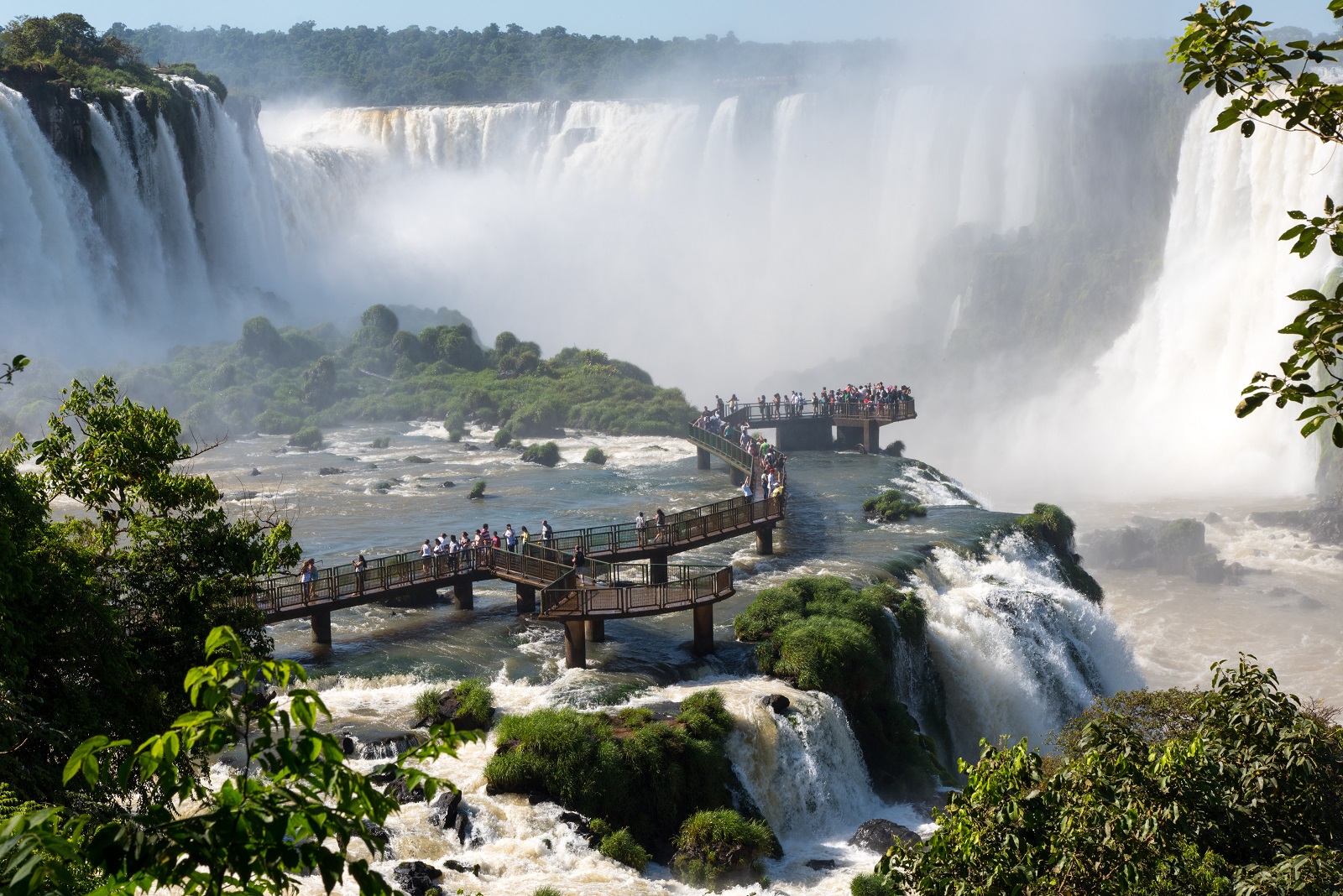
The Iguaçu waterfalls span nearly three kilometres with vertical drops of up to 80 metres, forming a semi-circle at the heart of two national parks that straddles the international border between Argentina and Brazil. The Brazilian side delivers the panoramic view — a single 1.6-kilometre trail that runs opposite the Argentine falls, designed for the postcard shot. The Argentine side, accessible by a 45-minute bus crossing, puts you inside the system. UNESCO
During peak rainy season, the water flow at Iguazu reaches 24.2 million litres per second, against a normal flow of 1.5 million — enough to fill an Olympic swimming pool in under half a second. Horizon Hugo
Allocate one full day per side. Iguaçu National Park drew 1.8 million visitors in 2024, its highest post-pandemic figure, which means arriving at the gate before 9am matters more than it used to. Iucn
Days 9–10: Return to Rio
Fly back to Rio for a final two nights. Use them differently than the opening two: Santa Teresa’s steep streets and its small museums over the standard tourist checklist, and at least one evening in the Lapa district, where the city’s music culture runs louder and later than anywhere else in South America.
2 — The Analytical Layer: What This Itinerary Actually Prioritises
The route above makes a quiet argument. Brazil’s identity as a travel destination has been almost entirely captured by its natural spectacles — waterfalls, rainforest, beaches — at the expense of its historical fabric. Ouro Preto and Paraty, both UNESCO-listed, receive a fraction of the visitor numbers that Iguazu does. That gap is partly logistical and partly a failure of storytelling.
Is Ouro Preto worth visiting in Brazil?
Ouro Preto is worth visiting for any traveller who wants to understand how Brazil’s modern identity was forged. The town’s baroque churches, gold-rush streets, and the legacy of the 1789 Inconfidência Mineira independence movement offer a historical density that no beach or waterfall can replicate. Budget a minimum of two full days to do it properly.
The picture is more complicated than a simple nature-versus-history binary, though. Brazil’s waterfalls aren’t just scenic spectacles — they’re ecological systems, contested political territories, and in Iguazu’s case, shared infrastructure between two sovereign nations. The river that becomes Iguazu also feeds the Itaipu Hydroelectric Dam, which supplies roughly 15% of Brazil’s total electricity. Visiting the falls without that context is a little like visiting Wall Street without knowing what a bond is.
That said, the historical sites have their own political textures. Ouro Preto’s gold didn’t build itself out of the ground — half a million enslaved Africans were among those who arrived in Minas Gerais after gold was discovered, a fact that the town’s museums are only now beginning to address with the directness it deserves. History Hit
3 — Logistics, Timing, and Second-Order Effects
The practical decisions on this itinerary are harder than the destinations.
Brazil is enormous. South America’s largest country contains 60% of the Amazon, the world’s largest wetland, and some of the most biodiverse national parks on the planet — which means that the distance between Chapada Diamantina and Iguazu Falls is roughly the same as London to Istanbul. Internal flights are non-negotiable on a ten-day trip. Budget for at least four domestic legs. Rough Guides
Best time to visit: The dry season — May through September — is the consensus choice for most of the country. Yet Iguazu is the exception that tests the rule. Waterfall flow peaks in March and April, when the rainy season has fully charged the river system. Visiting in the dry season means guaranteed access without flood-related closures; visiting in the wet season means the falls at full, almost overwhelming volume. The choice is legitimately difficult.
What this itinerary costs: A mid-range ten-day trip — four-star hotels, domestic flights, guided day tours, entry fees — runs roughly $3,000–$4,500 per person depending on season and booking lead time. Iguazu entry fees alone run around $40–$50 per side. Chapada Diamantina guides typically charge $60–$80 per person for a full-day excursion.
The second-order effect worth noting is that sustainable tourism infrastructure in Chapada Diamantina is thin. The park absorbs visitor pressure less gracefully than Iguazu, which has had decades of investment in walkways, ranger programs, and carrying-capacity management. Travelling with accredited local guides isn’t just logistically sensible — it’s the version of the visit that doesn’t quietly degrade the place you came to see.
4 — The Counterargument: Is Ten Days Too Ambitious?
Not everyone thinks a multi-destination Brazilian itinerary is a good idea. Experienced travel writers — and the operators who work the country professionally — frequently argue that the better ten-day trip is a focused two- or three-destination route: Rio and Iguazu, or Salvador and Chapada Diamantina, or the Amazon out of Manaus. The argument isn’t without merit.
Brazil’s internal travel is disruptive in ways that compact European itineraries are not. Domestic flights are subject to weather delays, particularly in the Amazon-adjacent north. Foz do Iguaçu and Lençóis are not well-connected to each other — the routing almost always runs through São Paulo or Salvador, adding transit time. And there’s a fatigue cost to covering five destinations in ten days that doesn’t show up in the itinerary until day seven, when the best version of yourself would rather swim in a natural pool than navigate another bus transfer.
The Rough Guides’ 10-day Brazil itinerary sidesteps the problem by keeping the route to three destinations — Rio, Ilha Grande, and Iguazu — arguing that depth beats breadth on a first visit. That’s a reasonable position. Ilha Grande’s beaches and Atlantic Forest trails are genuinely world-class, and the ferry from Angra dos Reis makes the transition from Rio feel unhurried.
The trade-off is that you lose Ouro Preto and Chapada Diamantina — the itinerary’s historical and off-grid beats. Whether that trade is worth making depends on what kind of traveller you are. If the answer is “someone who wants to understand Brazil,” the five-destination version is the harder and more rewarding choice.
The Country That Resists the Edit
Every Brazil itinerary is an argument about what the country actually is. The easy version — Rio, beach, Iguazu, repeat — sells the spectacle and skips the complexity. The harder version tries to hold both: the water and the colonial stone, the natural wonder and the historical wound.
What ten days in Brazil teaches you, if you let it, is that these things aren’t separate. The same volcanic geology that forged the gorge at Iguazu also produced the gold seams that drew the Portuguese into the interior and built Ouro Preto’s baroque churches with enslaved hands. The country’s landscape and its history are telling the same story. You just have to be willing to follow the trail far enough to hear both.
The waterfalls will do the rest.